






The best forcible entry training door isn't necessarily the heaviest one, the one with the most attachments, or the one that takes the most effort to force.
It's the door that allows your firefighters to get realistic repetitions without teaching them bad habits.
That's an important distinction.
There are plenty of ways to make a forcible entry prop difficult. You can add resistance until firefighters have to beat on it all afternoon. But a difficult prop isn't automatically a realistic prop, and a firefighter who becomes exceptionally good at defeating one simulator isn't necessarily becoming better at forcing real doors.
When a fire department evaluates a forcible entry training door, the better question isn't:
"Which door is the toughest?"
It's:
"Which door will give our members the best training for the buildings and doors we actually encounter?"
Here is what we would look at before spending department money on one.
Start With Your First-Due, Not the Equipment Catalog
Before comparing training doors, take a look at your response area.
What are your firefighters actually forcing?
A suburban department operating primarily in single-family homes may have different needs than an urban truck company encountering apartment buildings, mixed-use occupancies, steel commercial doors, security screens and multiple locking devices.
Walk your district.
Look beyond the front entrance.
Look at:
-
Rear commercial doors
-
Apartment entrances
-
Steel utility doors
-
Security screen doors
-
Multiple-lock residential doors
-
Drop bars
-
Padlocks and chains
-
Carriage bolts
-
Added security hardware
-
Older doors that have been modified repeatedly
Those are the problems your training program needs to reproduce.
Buying a sophisticated prop that doesn't resemble anything in your first-due doesn't make much sense.
Likewise, buying a basic one-position door because it's inexpensive may become limiting very quickly if your crews regularly encounter more complicated entry problems.
The Best Training Door Shouldn't Have One Answer
This is probably the biggest characteristic we look for in a forcible entry door.
Can the instructor change the problem?
A basic prop may be perfectly adequate for teaching a recruit where to place a Halligan and how to perform the mechanics of gap, set and force.
But what happens after everyone becomes proficient at that evolution?
If the door always swings the same direction, locks in the same location and provides essentially the same resistance, firefighters eventually stop reading the door.
They already know the answer.
That's when the prop starts losing training value.
A better training door allows instructors to manipulate the evolution.
Change the swing.
Move the locking point.
Add another point of resistance.
Change the tools.
Change the position from which firefighters have to operate.
Don't let every evolution begin with the firefighter standing comfortably in front of a familiar door.
The more variables an instructor can realistically introduce, the longer the prop remains useful.
Inward and Outward Training Should Be Non-Negotiable
If we were purchasing a general-purpose forcible entry door for a department, the ability to train on both inward- and outward-swinging doors would be high on the list.
These aren't interchangeable skills.
The door geometry changes.
Your approach changes.
Your tool position changes.
The mechanical advantage you're trying to create changes.
Even the size-up information available to the firefighter changes.
A firefighter who has performed hundreds of inward forces shouldn't encounter an outward-opening commercial door and suddenly have to work through the problem for the first time.
A good training platform gives crews repetitions on both.
It also gives instructors an opportunity to make firefighters identify the swing rather than simply announcing it before the drill.
Look for Multiple Lock Positions
Here's another question worth asking a manufacturer:
Where can I actually create resistance on this door?
If the answer is one fixed location at waist height, understand what will eventually happen.
Your firefighters will learn it.
They'll walk up, place the tool exactly where they've placed it during every previous drill and begin forcing.
Real buildings don't cooperate like that.
Locks can be high or low. Multiple locks may be present. Additional security may have been installed after the original door was hung.
That means the usable forcing area of the simulator matters.
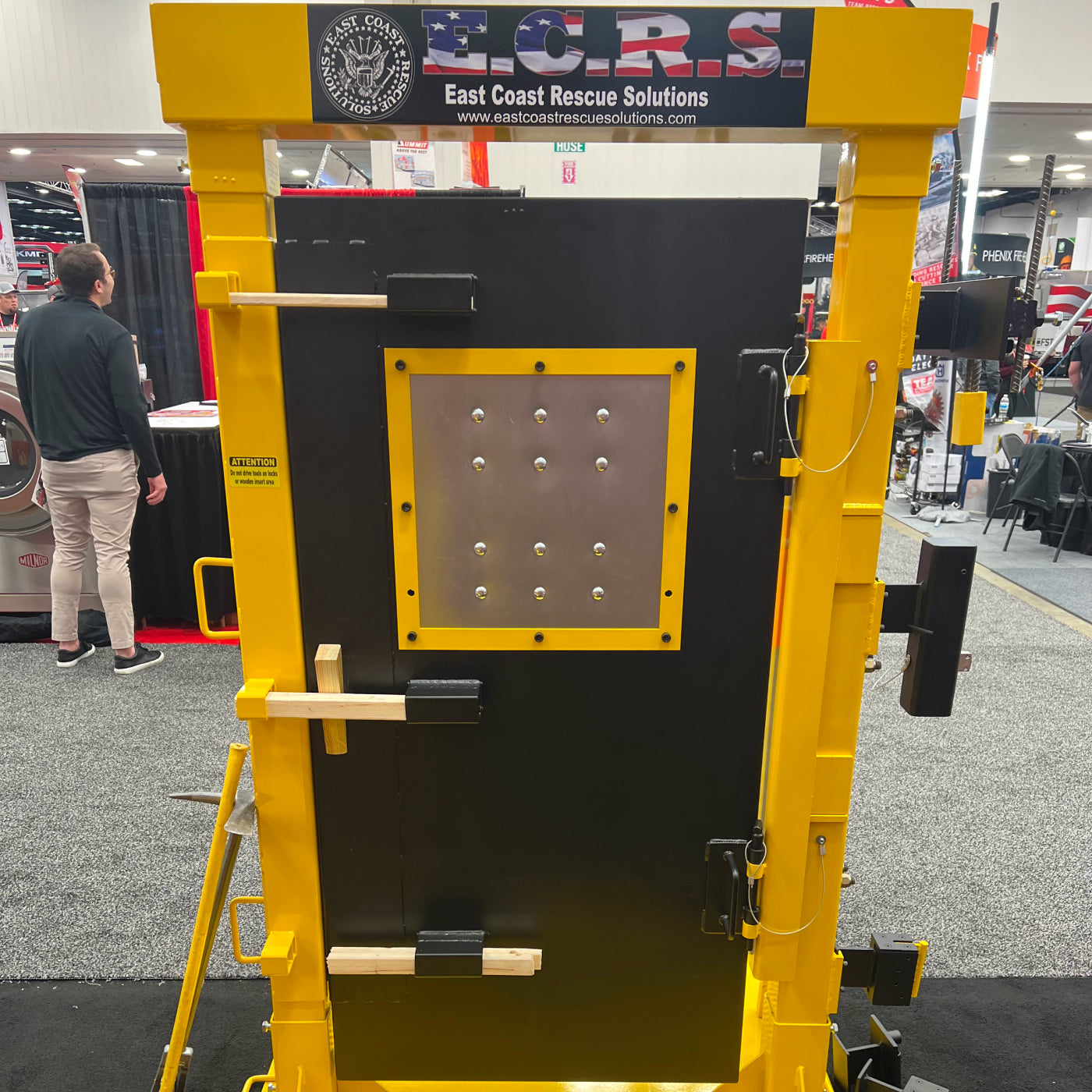
For example, the East Coast Rescue Solutions forcible entry prop uses three separate lock positions—top, middle and bottom—and provides more than 65 inches of vertical door stop that can be used during forcing evolutions.
That allows an instructor to move the problem around instead of giving firefighters the same target every time.
Don't underestimate how valuable that is.
Pay Attention to How the Door Moves
Firefighters need resistance.
But they also need feedback.
A real door assembly isn't a concrete wall.
Doors flex. Frames move. Gaps develop. The relationship between the tool, door, jamb and locking mechanism changes as force is applied.
Firefighters learn to read that movement.
You can often tell whether you're gaining something by what you're seeing and feeling through the tool.
A simulator that is simply built to be as rigid as possible can lose some of that training value.
When comparing forcible entry doors, ask how the door behaves under force.
Does it flex?
Can the firefighter see progress?
Does tool placement matter?
Can a poor set be distinguished from a good one?
Or does every evolution become a contest to see who can swing the axe hardest?
ECRS specifically engineers its training doors to flex like a real door rather than remaining completely rigid.
That's the kind of design consideration we care about more than simply asking how many pounds of steel are in the prop.
Durability Still Matters—A Lot
Realism doesn't matter if the prop can't survive the training schedule.
A department may put a tremendous number of repetitions on a forcible entry door.
Consider a recruit academy with 25 firefighters.
Give each recruit only four repetitions and you've already put the prop through 100 forces.
Now add company drills, refresher training, mutual-aid training and the firefighters who walk past the prop on the apparatus floor and decide to get a few repetitions.
The numbers add up quickly.
Look at the entire structure, not just the door slab.
Inspect or ask about:
-
Frame construction
-
Reinforcement at high-stress areas
-
Hinges
-
Welds
-
Replaceable wear components
-
Consumables
-
Maintenance requirements
-
Availability of replacement parts
-
What happens when something finally does wear out
If you're going to use a battering ram against the system, frame construction becomes even more important.
ECRS, for example, adds additional steel to the frame for its battering ram configuration rather than simply attaching a striking plate to the existing door structure.
That's a small detail on a specification sheet but a significant one when firefighters start repeatedly driving a ram into the prop.
Don't Judge a Door by How Hard It Is to Force
This is worth emphasizing.
An instructor can make a prop extremely difficult and create a terrible training evolution.
More resistance isn't always better.
If firefighters are abandoning technique, using poor body mechanics and beating on a door until they're exhausted, ask what skill is actually being reinforced.
There are times when high resistance is useful.
Firefighters absolutely need to understand that some doors are going to fight them.
But resistance should serve the training objective.
For newer firefighters, instructors may want a cleaner force that allows them to concentrate on tool placement and mechanics.
As proficiency improves, resistance can increase.
Then other variables can be introduced.
Good training progresses.
The prop should allow that progression rather than requiring every firefighter to fight the exact same door.
Reset Time Matters More Than Departments Expect
Imagine you're running a drill with 18 firefighters.
The first pair forces the door.
Now everybody waits while the instructor spends several minutes rebuilding the prop.
Do that after every evolution and you've turned a hands-on training night into a standing-around-and-watching night.
Reset time affects how many meaningful repetitions firefighters can get.
That's why it belongs in the purchasing conversation.
Ask:
How quickly can the door be reset?
What materials are consumed during each force?
How much preparation is required between evolutions?
Can another instructor reset while the first instructor provides feedback?
How many realistic repetitions can we reasonably complete in an hour?
Those questions don't sound as exciting as discussing door construction, but once the prop is sitting in your station, they matter.
Think Beyond Conventional Forcible Entry
A good forcible entry training door should be excellent at teaching conventional entry first.
Don't sacrifice the fundamentals for a collection of gimmicks.
But once those fundamentals are covered, the ability to expand the platform becomes valuable.
Your crews may also need to practice:
-
Through-the-lock entry
-
Hinge pulling
-
Hinge cutting
-
Padlock cutting
-
Drop-bar attacks
-
Carriage-bolt attacks
-
Battering ram operations
-
Steel security doors
-
Multiple locking points
-
Cutting operations
This is where a modular training system can make sense.
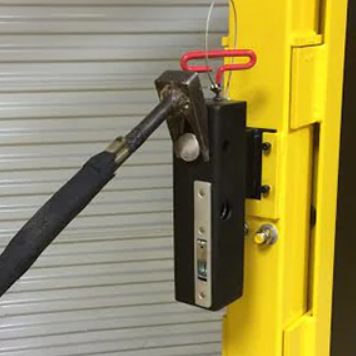
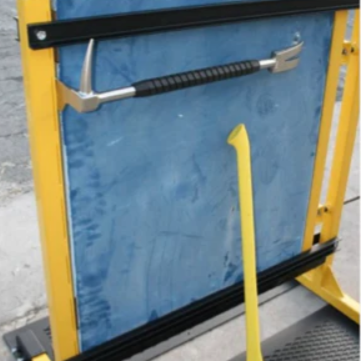
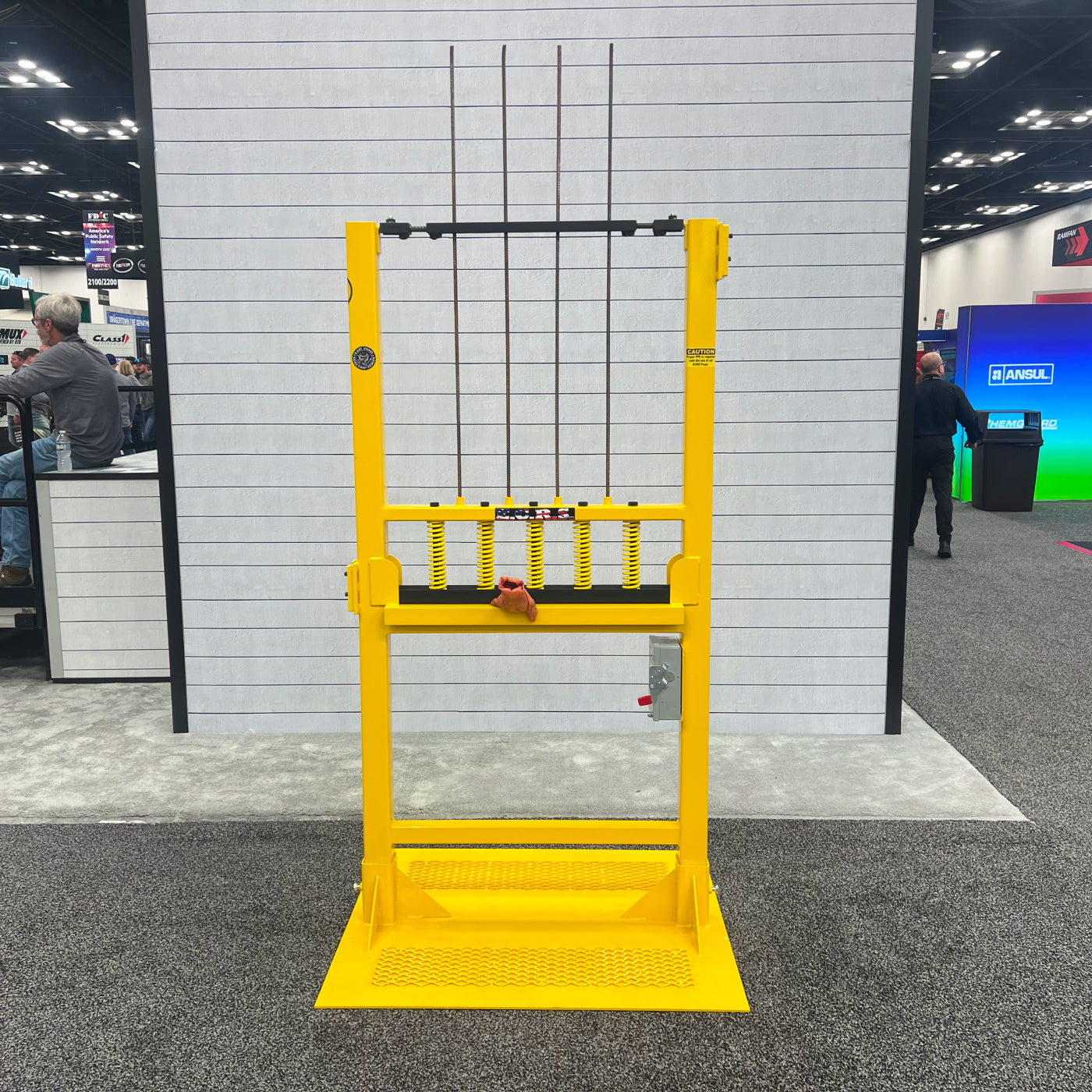
The ECRS GEN3 and GEN4 doors, for example, include three receivers that can accept additional training modules. Their All-In-One system expands the platform into hinge pulling and cutting, rebar work, through-the-lock training and padlock cutting.
The GEN4 also allows a second steel door or steel security screen door to be mounted to the prop.
That doesn't mean every department needs every attachment.
It means the department can expand the training program without necessarily replacing the core door.
Portability Can Determine How Often the Prop Gets Used
We've seen plenty of training equipment that looks great when it's installed at the training center.
Then nobody wants to move it.
If your department has a permanent training facility and the door will remain installed, this may not matter much.
For everyone else, it does.
A department may need to move the door:
-
From the apparatus bay to the apron
-
Between stations
-
Into a training tower
-
Onto a trailer
-
Out of the way after drill night
-
To regional training events
Ask how the prop moves before buying it.
Can it be broken down?
How many firefighters does it take to relocate?
Does it require equipment to move?
Can a mobility system remain out of the way during training?
ECRS's GEN3 and GEN4 doors can be disassembled, and an optional dolly system is designed to allow one person to move the door around a station or training ground. The dolly is then removed when the prop is being used.
That's a practical feature, not a flashy one.
Practical features tend to become much more important after you've owned the equipment for six months.
The Best Door Is One Your Instructors Can Keep Changing
This is where we would separate a good forcible entry prop from a great training platform.
After 500 repetitions, can the instructor still create a useful problem?
That's the test.
If firefighters can approach the door without looking at it and know exactly where to put the Halligan, the training value has dropped dramatically.
Fire-service instructors have warned about this exact problem: firefighters can become so accustomed to their department's prop that familiarity actually interferes with preparing them for real-world doors.
The instructor has to stay ahead of that.
Change lock locations.
Change resistance.
Change door direction.
Change tools.
Change firefighter positions.
Create restricted working areas.
Introduce reduced visibility.
Put firefighters in full PPE and SCBA.
Make them work strong-handed and weak-handed.
Give them a door that doesn't open completely after it's forced.
Require them to control the door after entry.
You don't necessarily need a different prop for every one of those evolutions.
You need a versatile platform and instructors willing to use it creatively.
Should You Buy a Commercial Door or Build Your Own?
Firefighters have been building forcible entry props long before commercially manufactured simulators became common.
A well-designed homemade prop can absolutely provide useful training.
For a department with skilled fabricators, available materials and a clear understanding of what it wants to accomplish, building a prop may make sense.
The tradeoff is consistency, engineering, durability and instructor time.
Someone has to design it.
Someone has to fabricate it.
Someone has to determine how resistance will be created.
Someone has to repair and modify it.
And somebody needs to make sure the finished product teaches the intended technique without introducing unnecessary hazards or bad habits.
A commercial training door costs more upfront, but departments are purchasing a developed system rather than beginning with a fabrication project.
Neither answer is automatically right for every department.
The important thing is not to confuse "we can build something firefighters can force" with "we can build a realistic, repeatable forcible entry training system."
Those are different standards.
What Would We Look for in a Forcible Entry Training Door?
If we were evaluating doors for a fire department, our shortlist would be based on these questions:
Can we train inward and outward forces?
Can we change the location and amount of resistance?
Does the door provide realistic movement and feedback?
Can recruits learn fundamentals without having to fight the prop?
Can experienced firefighters still be challenged?
Can we incorporate the tools our crews actually carry?
How quickly can instructors reset it?
Will the frame survive years of repeated training?
Can we expand the system as our training program develops?
Can we realistically move and store it?
And perhaps the most important:
Does it resemble the forcible entry problems our firefighters encounter in our response area?
If the answer to those questions is yes, you're probably looking at a useful training platform.
So, What Is the Best Forcible Entry Training Door?
There isn't one door that's automatically best for every fire department.
A better way to define "best" is the training door that gives your department the most realistic and varied repetitions for the forcible entry problems your firefighters are expected to solve.
For a department that wants a purpose-built, expandable system, the ECRS GEN3 and GEN4 are designed around many of the criteria we've discussed: inward and outward forcing, multiple lock positions, a large usable forcing area, realistic door flex, modular training attachments, portability options and configurations for additional steel or security doors.
But whichever training door your department considers, don't buy it because it looks indestructible at a trade show.
Think about the firefighter who will stand in front of it three years from now.
Will that firefighter have to size up the door?
Will they have to use good technique?
Will they have to communicate?
Will they have to recognize when the first approach isn't working?
Will the instructor still be able to change the problem?
If so, you've bought more than a door prop.
You've bought a platform that can continue developing forcible entry firefighters long after the novelty of the new equipment wears off.